Kubrick’s Hidden Message Uncovered and Explained
What was Kubrick really trying to say in ‘Eyes Wide Shut’? Or perhaps he wasn’t — but said it anyway.
In recent months, interest in ‘Eyes Wide Shut’ (1999) has surged again, largely due to renewed public discussion surrounding the so-called Epstein files.
Once again, a bone has been thrown to the public. Why? Draw your own conclusions.
However, that’s not the topic of my post. So, forget Epstein: ‘Eyes Wide Shut’ is about something much darker.
Recently, I came across a YouTube comment in Russian claiming that
despite the allegedly deleted scenes, Stanley Kubrick still managed to communicate his core message: that the family, as a society’s highest spiritual value, is under attack by powerful elites.
It is an interpretation that fits neatly into many contemporary political narratives.
I believe, whether intentionally or not, Kubrick reveals something entirely different: the illusion of family values and the invincibility of human nature.
The Real Meaning of ‘Eyes Wide Shut’
To me, the central idea of ‘Eyes Wide Shut’ is not the hidden darkness of global elites.
It is the hidden darkness of the average, respectable family.
Kubrick suggests that what we often call ‘normal family life’ may be not what we think or not it is designed to be. Beneath social conventions lies a complex world of desire, fantasy, dissatisfaction and emotional isolation.
His message seems to be that so-called ‘spiritual values’ are often less powerful than human nature itself.
No matter how strongly people believe in moral ideals, they frequently struggle against impulses they neither understand nor control.
Alice Harford’s Confession: The Film’s Crucial Moment
Kubrick places his most important revelation into the confession of Alice, Nicole Kidman’s character.
Alice tells her husband, Bill Harford, a young and successful doctor, played by Tom Cruise, about a naval officer she once saw.
Whether the encounter was real or imagined hardly matters. What matters is her perception and her conclusion:
‘If he wanted me, even for just one night, I’d give up everything for it. You. Helena (their daughter, auth.). My whole f*cking future. Everything.’
It is not about just sex: it is about something deeper — a long for aliveness she’s lost over the years of her marriage. Just for one fleeting moment.
Isn’t it a human tragedy?
The Trap of ‘Righteousness’
Alice’s crisis is existential.
She once worked as an art gallery manager, but that chapter of her life is gone.
Bill escapes into professional and social activity.
Alice escapes into nothing.
Both escape into marijuana.
Kubrick shows that marriage does not reprogram a person and does not erase desire. It merely gets pushed into the unconscious — into fantasies, dreams and secret inner worlds.
This idea becomes especially clear in Alice’s dream in which she laughs while having sex with countless men.
The laughter is not directed at Bill. It feels like it is aimed at the identity she has been forced to inhabit.
She experiences freedom not from her husband she loves anyway but from her grueling role.
Two Thousand Years of War Against Human Nature
One of the film’s recurring themes is the conflict between social morality and human nature.
Modern civilization is built upon self-control, discipline and restrictions. Yet desire never disappears.
And the stricter the rules, even unspoken, the stronger desire is. The darker the shadow.
Rather than accepting and understanding this stuff, people attempt to suppress it.
The result is an endless internal and external war — against those who dare to choose themselves, to decide what is right and what is wrong for them.
Here may be appropriate to recall the famous lyrics of Viktor Tsoi, Soviet rock star of the 1980s:
«И две тысячи лет война, война без особых причин…»
‘And for two thousand years there’s been a war, a war without any special reason.’
A senseless, endless war.
Perhaps, someone benefits greatly from that endlessness. And perhaps, the only beneficiary is the people themselves.
Why Bill Enters the Secret World
After Alice’s confession, Bill’s understanding of reality begins to collapse.
He realizes that his marriage is not what he believed it was.
Moreover, he realizes that he is not who he believed he used to be.
He too is ruled by suppressed desires. His nocturnal walk around New York is an evident flight from reality: the wandering nights, the temptations, the narcotic haze surrounding everything that happens.
His intrusion into the secret ritual is not a journey into an alien world. It is a journey into his own unconscious. As if he was returning to himself. Like Alice, just for a moment.
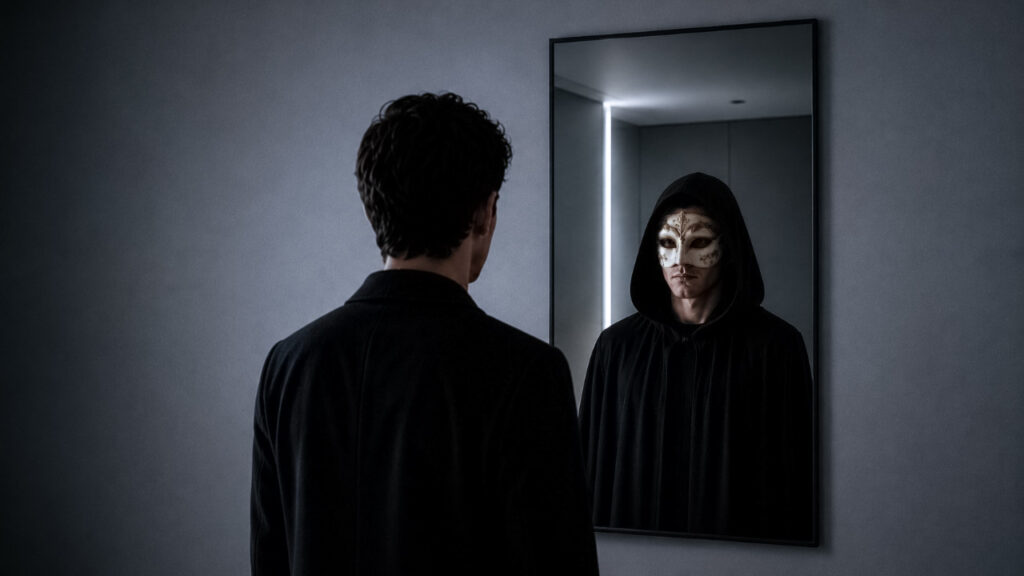
In this reading, the masked figures represent hidden desires rather than external enemies.
The secret society becomes a symbolic mirror. And the man in the red cloak seems to pour more of his soul into his ritual than Bill and Alice ever invested in their marriage, the color of which is gray.
The Most Iconic Scene
One of the film’s most iconic — and truthful — moments comes in the final toy store scene.
As Bill and Alice talk about their future, two men dressed in black appear to guide their daughter away.
The parents barely notice.
This is how children often end up swallowed by ‘the industry’. Not because of poverty or dysfunctional households, but because of emotional neglect. Education, wealth, and social status offer no guaranteed protection against that reality.
And, as you can see, Epstein has nothing to do with that.
Why People Prefer to Keep Their Eyes Wide Shut
The ending of ‘Eyes Wide Shut’ refuses to provide clear answers. Kubrick seems to leave them entirely to the audience.
My personal conclusion is simple:
People are often fascinated by stories of elite corruption because it is easier to examine the darkness in others than in themselves.
The possibility that ordinary lives contain the same contradictions, desires, and moral compromises is far more uncomfortable. The masses condemn the elites because they are terrified of confronting their own abyss.
That is why most people prefer to live with their eyes wide shut without an apparent intention to change anything.
And that may be the real message Kubrick left behind.